
Assessing adherence to GLP-1 receptor agonists and insulin in clinical practice: A practical guide
Injectable therapies are an important part of diabetes management, particularly insulin and glucagon-like peptide-1 receptor agonists (GLP-1 RAs), which play a key role in glycemic control. Yet prescribing an effective injectable is only part of the equation: patients must be able to initiate, use, and continue treatment as intended.1 Poor adherence explains much of the gap between trial and real-world glycemic outcomes with these therapies.2 Measuring adherence to diabetes injectables requires more than relying on refill data alone. Pharmacy-based measures such as proportion of days covered (PDC) and medication possession ratio (MPR), along with self-reported measures, are used to assess medication adherence.3
Why does measuring adherence to injectable diabetes therapies matter?
Measuring adherence matters because poor glycemic control may reflect missed or incorrectly administered doses rather than treatment failure. GLP-1 RAs and insulin are important therapies for glycemic control, but in developed countries, adherence to long-term therapy for chronic illness averages about 50%.4 In diabetes, poor adherence is associated with worse glycemic control,5 and with greater healthcare utilization and higher healthcare costs.6
A real-world analysis found glycated hemoglobin (HbA1c) reduction with GLP-1 RAs of 0.52% versus 1.30% in published randomized controlled trials (RCTs); poor medication adherence accounted for approximately three-fourths of that gap.2 The ABC taxonomy separates adherence into initiation, implementation, and discontinuation, with persistence describing the time from initiation to the last dose before discontinuation.1 Each stage can fail for a different reason, which is why the next question is whether injectables differ from tablets in the first place.
Injectables vs tablets in diabetes: is there a difference in adherence?
Adherence rates appear broadly similar in these separate datasets, but the figures are not directly comparable because the populations and measurement methods differ. A meta-analysis of 156 studies involving 10,041,928 patients found that 54% of oral antidiabetic drug users were adherent (95% confidence interval [CI] 51–58%).7 For basal insulin, pooled adherence was 55.6% (MPR >80%; 95% CI 45.3–65.6%), indicating that approximately 44% were non-adherent.8
Persistence and discontinuation may differ by injectable class. Basal insulin non-persistence increased from 20.3% at 6 months to 36.5% at 18 months.8 In a 6-study comparison within a 48-study meta-analysis, GLP-1 RAs had higher discontinuation than long-acting insulin analogues (odds ratio, OR, 1.95; 95% CI 1.17–3.27), although definitions of adherence and persistence varied across studies.9
For practice, the key point is that injectables are harder in some ways and easier in others (Figure 1).
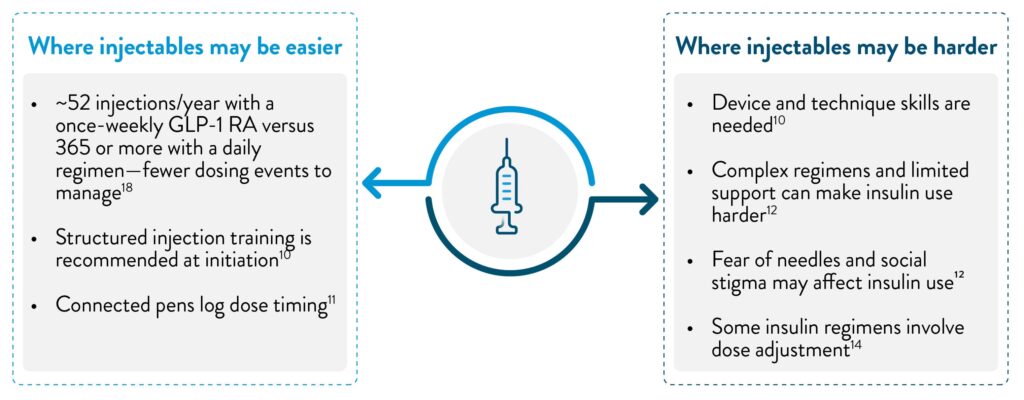
Figure 1. Factors that may ease or hinder adherence to injectable therapies compared with tablets.
Those differences shape which barriers actually arise in practice.
What issues lead to poor adherence with diabetes injectables and insulin?
Non-adherence is rarely one problem. The main barriers are regimen burden and injection logistics, incorrect technique, side effects, psychological concerns, access barriers, and unplanned dose changes.
- Regimen burden and injection logistics: Injectables can add regimen and administration demands, depending on the treatment. Complex regimens and limited support can make adherence harder to sustain.10,12
- Incorrect technique: Some patients may use insulin as intended but still make injection-technique errors. Dose selection, needle withdrawal, and priming are important steps that can affect insulin administration.10
- Side effects and tolerability: Gastrointestinal symptoms are an important contributor to GLP-1 RA discontinuation. Concerns about hypoglycemia may also affect insulin adherence.12,13
- Psychological barriers: Fear of needles, embarrassment about injecting in public, and other treatment-related concerns can affect insulin use.12
- Practical and access barriers: Cost, medication availability, complex devices, and limited education can undermine adherence.15
- Silent self-adjustment: Changes in dosing behavior may not be fully captured by refill-based measures alone.16
Grouping these drivers using the capability, opportunity, motivation–behaviour (COM-B) model helps match each barrier to an intervention (Figure 2).17 Knowing which barrier is present also shapes how it should be measured.
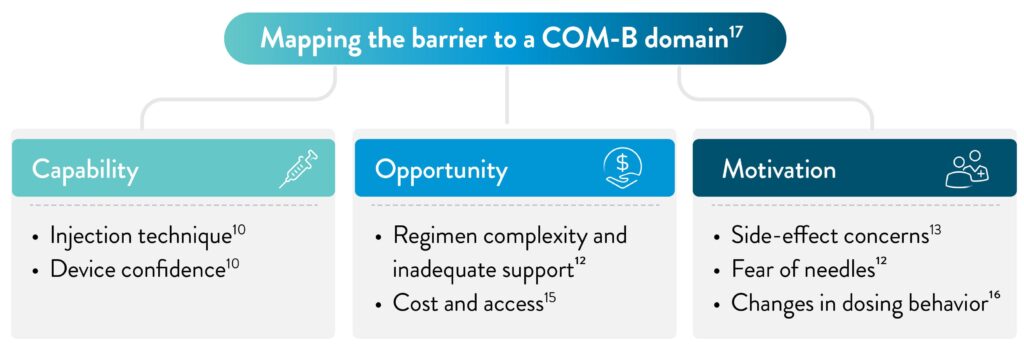
Figure 2. Mapping the barrier to a capability, opportunity, motivation–behavior (COM-B) domain can help guide the intervention.
How do I assess adherence to GLP-1 receptor agonists (weekly injectables)?
The assessment should reflect the regimen: for weekly GLP-1 RAs, pharmacy-claims metrics can be used to assess adherence. The proportion of days covered (PDC) is commonly used to quantify medication availability from refill records; ≥80% is a commonly used benchmark in claims-based adherence analyses.3,18 Medication possession ratio (MPR) is another refill-based measure of medication availability.16
Dosing frequency may influence adherence and persistence. In United States (US) clinical practice, once-weekly initiators had longer median persistence than daily initiators (333 vs 269 days; hazard ratio, HR, 0.80, 95% CI 0.71–0.90) and greater HbA1c reduction at 6 months (−1.1% vs −0.9%).18 At 12 months, adherence was also higher with once-weekly treatment (46% vs 34%).18 A separate meta-analysis also supports higher adherence with once-weekly versus once-daily injectable GLP-1 RAs.19
- Refill records: Review PDC or MPR, and check whether refills have stopped altogether. Gaps within a period may indicate missed doses; a prolonged absence of refills may suggest discontinuation.16
- Structured self-report: Use a structured self-report assessment to identify missed doses and other adherence behaviours.3 For example, ask about the last dose taken, timing, and any skipped doses.
Claims data assume a filled prescription equals an injected dose. Pair them with a conversation about the actual routine. Insulin needs a different approach again, because the dose itself changes over time.
How should insulin adherence be measured in real-world practice?
A practical real-world approach combines structured self-report with pharmacy claims, using connected-pen data when objective timing information is needed. A 2023 systematic review of 50 studies identified four assessment approaches: self-report, pharmacy claims, insulin counts, and insulin-pen data; a <80% threshold defined non-adherence in nearly half of studies.16
Each approach has trade-offs to weigh. None of these approaches alone confirms both that a dose was administered and that it was administered correctly.16
- Self-report scales are used to assess adherence and can provide information on medication-taking behavior but may be subject to recall bias.3,16
- Pharmacy claims (MPR, PDC) are objective and scale across whole populations without patient effort, but depend on access to claims data, and insulin titration makes “days covered” harder to define.16
- Insulin counts (used pens or vials) need no claims data and can be done anywhere but rely on the patient bringing devices to clinic and are cumbersome to repeat.16
- Connected insulin pens can provide objective information on injection timing and dose delivery.11 In real-world analyses, smart-pen data have identified missed and mistimed insulin doses and their association with glycemic outcomes, providing information that can help inform diabetes-care-team counseling.11 The American Diabetes Association (ADA) Standards of Care—2026 recommend offering connected insulin pens to people taking multiple daily injections when appropriate.20
That still leaves the question of whether the injection itself is being performed correctly.10
Is the patient using the correct dose and technique?
Check technique by asking the patient to demonstrate, because most adherence metrics cannot determine whether an administered dose was delivered correctly.10,16 A patient may be fully persistent yet inject incorrectly: refills arrive on schedule, self-report looks fine, and PDC sits above 80% while the delivered dose is wrong.
Technique problems are common. Lipohypertrophy is common in people using insulin and is strongly associated with injection-related factors, particularly incorrect injection-site rotation and needle reuse.21 A recent systematic meta-analysis identified incorrect site rotation and needle reuse as important modifiable risk factors for Lipohypertrophy, highlighting the importance of injection-technique education.21
For insulin, check the product, dose, device, and titration stage directly, asking the patient to demonstrate each step from preparation through injection, disposal, and storage.10 Problems fall into two groups (Figure 3): those arising at the injection itself, and those arising from how the regimen is managed between visits.
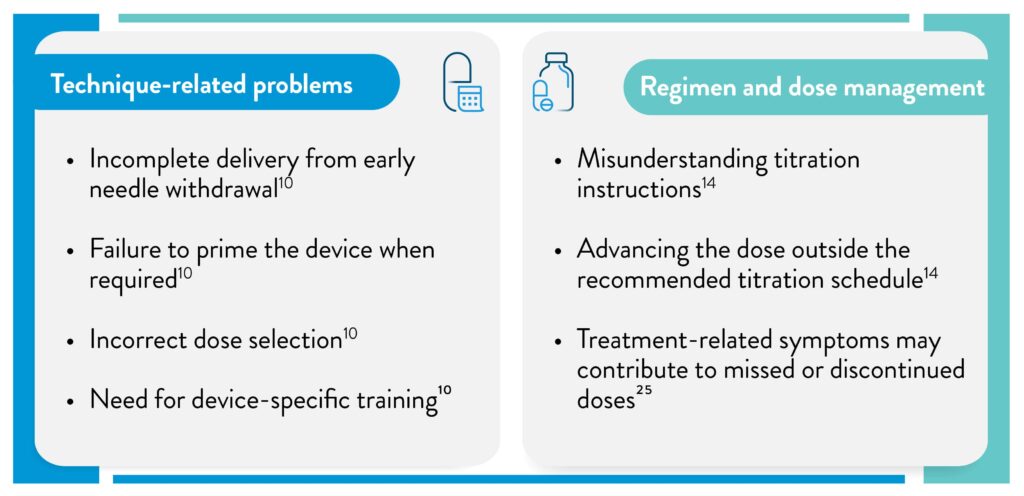
Figure 3. Common problems with injectable therapy, grouped by whether they arise at the injection itself or from regimen and dose management between visits.
A brief teach-back technique can help: “To make sure I explained it clearly, could you show me how you prepare and administer the injection?” This checks understanding without framing the interaction as a test.23 Technique is only part of the picture when a patient is also feeling unwell on treatment.
How do I measure adherence to antidiabetic regimens when side effects are present?
When side effects are present, pair objective data with a targeted symptom history because standard metrics may not distinguish a tolerability-related interruption from other causes of missed doses. For GLP-1 RAs, gastrointestinal (GI) symptoms are common and can contribute to discontinuation.13 In SURPASS-2, nausea occurred in 17–22% of tirzepatide and 18% of semaglutide 1 mg users, while vomiting occurred in 6–10% and 8%, respectively.24 Premature treatment discontinuation due to GI adverse events occurred in approximately 3–7% of participants in the tirzepatide arms across the SURPASS trials.25
When side effects are in play, broaden the assessment:
- Ask about silent dose reduction. Try a specific, non-judgmental question: “Have you changed how much or how often you inject because of how it made you feel?”
- Use structured questions. Ask about missed or intentionally changed doses, particularly when patients report side effects or concerns about treatment.
- Re-measure after any change. GI symptoms commonly occur during dose escalation and may lessen over time; dose-escalation adjustments may be considered to improve tolerability when clinically appropriate.22
How can HCPs address adherence problems?
Once the barrier is identified, match the intervention to it.17
- Simplify the regimen where appropriate. Consider once-weekly GLP-1 RAs when clinically suitable.18
- Verify technique, not just refills. Reassess technique at initiation and after device changes, and when glycemic control worsens without an obvious explanation.10,23
- Manage side effects proactively. Set expectations, follow recommended dose-escalation schedules, and address symptoms early, modifying or stopping treatment when clinically appropriate.22,25
- Address fear and beliefs. Motivational interviewing may help support behavior change. Technique education and patient support can help address injection concerns.12,26
- Maintain ongoing follow-up. Non-persistence rises over time, supporting continued review of adherence, particularly when a regimen is new or has changed.8
Implementation tips for clinicians
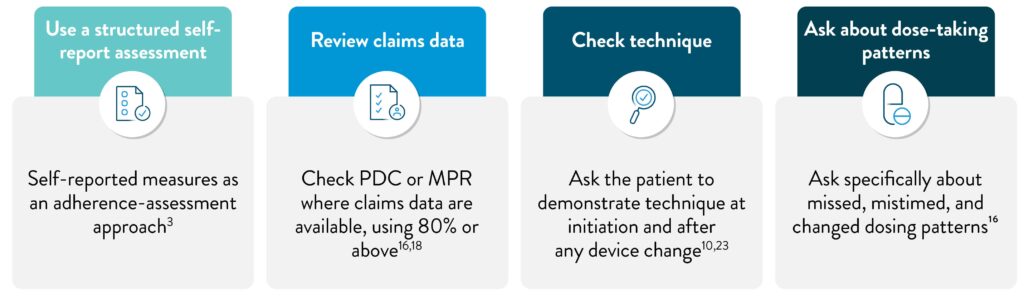
Figure 4. Four practical checks for measuring adherence to diabetes injectables and insulin.
Key Takeaways
- Assess adherence before attributing poor glycemic control to treatment failure.
- Identify the specific barrier driving non-adherence.
- Combine refill data with structured patient conversation.
- Ask patients to demonstrate their injection technique.
- Pair adherence data with targeted symptom assessment when side effects occur.
- Match the intervention to the identified adherence barrier.
- Continue reviewing adherence as treatment and regimens change.
This article was written with the assistance of generative AI technology and reviewed for accuracy.
FAQ
A: Measurement can help identify the barrier; the intervention should then be matched to that barrier.17 Behavioral approaches such as motivational interviewing may help address beliefs and concerns that affect treatment use.26
A: Ask about dosing routinely, including at follow-up visits. Reassess technique after a device or regimen change and whenever there is concern about injection technique.10 Early follow-up is particularly useful when a regimen is new or being titrated.
A: Use a specific, structured question about missed doses. For example, ask, “How many doses did you miss in the last 2 weeks?” Self-reported measures are one approach used to assess medication adherence.³
A: Current evidence supports the use of smart-pen data for objective measurement of missed and mistimed doses, and missed doses are associated with lower time in range. 11 The study was observational, so it shows association rather than proof that the device itself improves adherence. The clinical value is in using these data to identify missed or mistimed doses and guide a targeted discussion with the patient. 11,20
A: Yes. Refill or self-reported adherence does not confirm correct injection technique or appropriate dosing. If glycemic control remains suboptimal despite apparent adherence, review the prescribed dose, titration stage, device use, injection technique, and other factors that may affect treatment response. 10,14